
Fully Automated Microcirculatory Evaluation
PAD-IQ delivers consistent, reproducible SPP measurements with minimal operator intervention. The automated protocol ensures standardized testing across all patients and technicians.
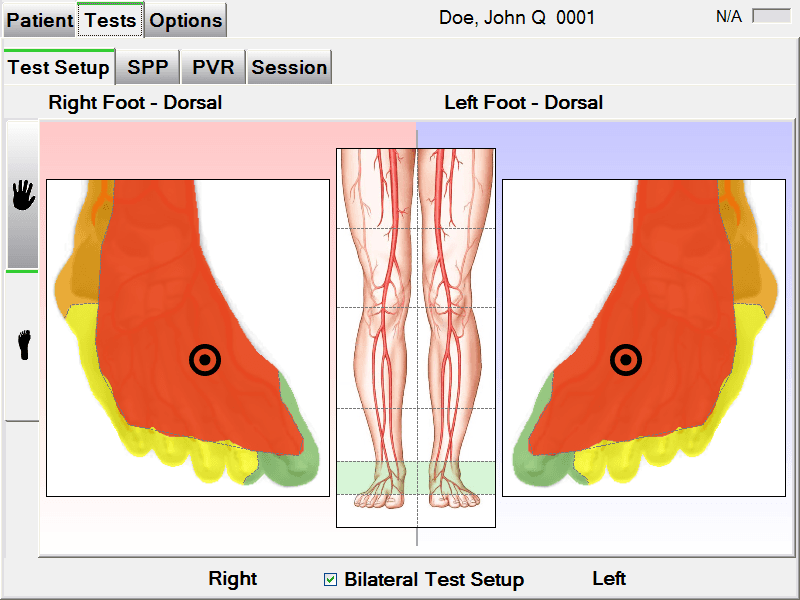
Touch screen test setup for bilateral dorsal foot SPP measurement
Skin Perfusion Pressure measurement uses a provocative functional maneuver test with reactive hyperemia. A laser Doppler sensor is placed on the patient, arterial occlusion is applied, and Post Occlusion Reactive Hyperemia (PORH) is measured to assess microvascular function.
Automated Test Procedure:
- 1Laser Doppler sensor is placed in close proximity to the area of concern using a temporary adhesive
- 2Blood pressure cuff is wrapped over the laser sensor on the patient's leg, digit, or foot
- 3Cuff is automatically inflated to a pressure above systolic (typically 90 mmHg) and held for 10 seconds until volume flow drops below 0.1%
- 4Cuff pressure is slowly released at a controlled rate of 10 mmHg every 5 seconds
- 5SPP is recorded at the cuff pressure where perfusion returns - the capillary opening pressure
- 6Graphical recording shows cuff pressure (x-axis) versus detected perfusion (y-axis)
Clinical studies demonstrate an 80% reduction in test time compared to TcPO2/TCOM testing:
| Metric | SPP/PVR | TCOM/ABI |
|---|---|---|
| Mean Test Time | 6.7 minutes | 35.4 minutes |
| Median Test Time | 6 minutes | 35 minutes |
| Range | 3-15 minutes | 5-47 minutes |
| Per-Level SPP Time | 5-7 minutes | N/A |
| Per-Level PVR Time | 30 seconds | N/A |
Source: SAWC 2009 - Bailey, Schechter et al. "TcPO2 and SPP Evaluation: A Direct Comparison of Technologies"
SPP can be measured at multiple anatomical sites to provide comprehensive assessment:
Lower Extremity Sites
- Foot - Dorsal
- Foot - Plantar (medial, lateral)
- Toes (great toe, lesser toes)
- Ankle
- Below knee (calf)
- Above knee (thigh)
Testing Advantages
- Simultaneous bilateral testing
- No anatomical restrictions
- Can test near wounds
- Angiosome-specific assessment
- Avoid bony prominences, veins, varicosities
Patient Preparation
For optimal results, patients should avoid caffeine, alcohol, smoking, vigorous exercise, and salty foods at least 24 hours before the examination. The testing room should be quiet with comfortable temperature to avoid stressors that might induce vasoconstriction. Ambient light should be reduced as the laser Doppler sensor uses light transmission for red blood cell detection.
Test Automation
- Automatic cuff inflation and controlled release
- Real-time perfusion monitoring
- Automatic SPP detection at capillary opening
- Interpretable graphical output generation
- Automatic report creation with findings
Data Management
- Patient vascular history capture
- Risk factor documentation
- Wound description and imaging
- Automatic CPT/ICD code population
- EMR integration with encrypted transmission